

.png)
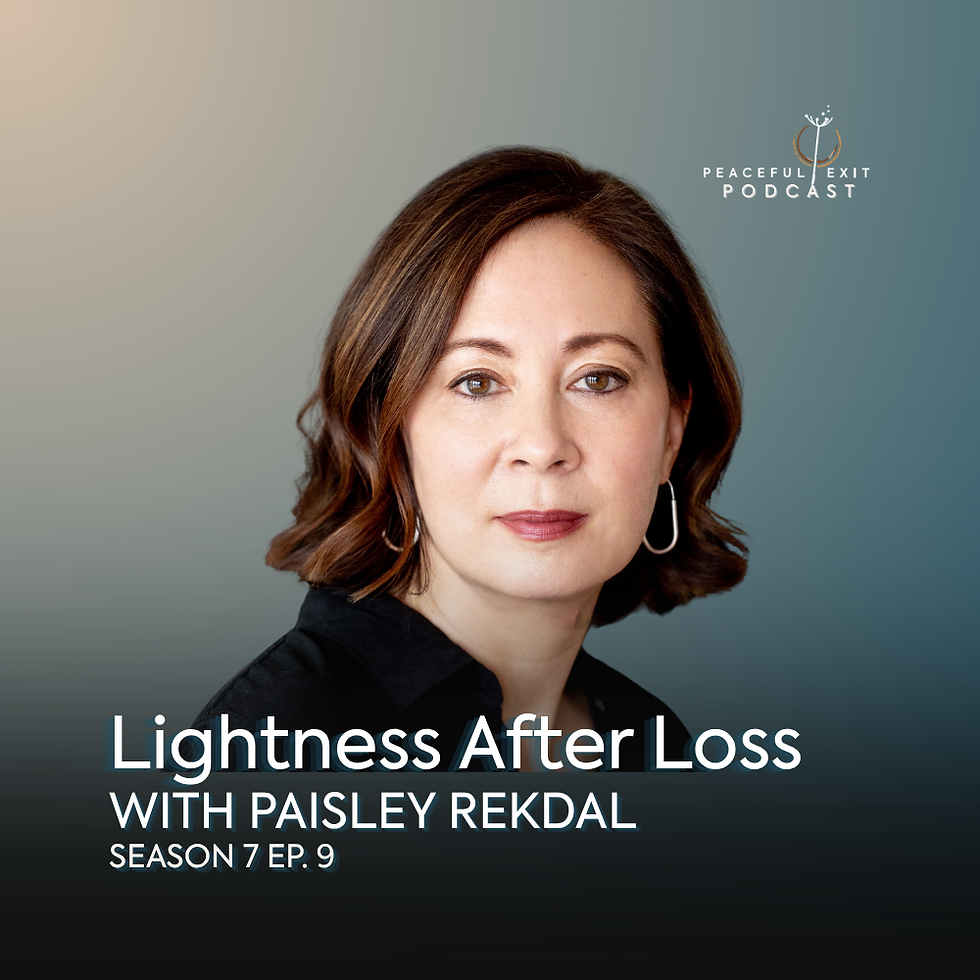
Lightness After Loss with Paisley Rekdal
Paisley Rekdal: Poetry is a physical act, as well as a mental act, as well as a communal act, as well as a private act. You know, it takes physical effort to write a poem. It takes mental effort to think a poem. It takes bodily effort to say that poem, recite that poem. And then when you're in the proximity of other people, for them to hear it and for them to start remembering that poem and sharing it, that instead of it being perpetual mourning, it's perpetual life in its own way.
[00:00:37] Sarah Cavanaugh: Welcome to Peaceful Exit, the podcast where we talk to creatives about death, dying, grief, and also life. I'm Sarah Cavanaugh, and my guest today is poet Paisley Rekdal. She's a professor and a former poet laureate of Utah. She has spent her career writing about history, memory, and loss — her own, and also collective losses like from war and immigration. In this episode, Paisley and I talk about how she cared for her father as he died, the complicated emotions that came from that experience, and what poetry uniquely offers grievers. We also discuss her grandmother's choice to die by euthanasia at over 100 years old — what Paisley calls the “gold standard” of death— and why she believes there's a lightness that can follow loss
Welcome to Peaceful Exit.
[00:01:30] Paisley Rekdal: Thank you so much for having me
[00:01:32] Sarah Cavanaugh: You've been an accomplished writer and poet for some time now. How has the atmosphere surrounding the work you do changed over time, particularly given the subject matter and the topics you tend to focus on?
[00:01:44] Paisley Rekdal: For a long time I've been writing mostly about history, my relationship with history, my thoughts about history and art. I would say living in Utah, especially at a time of extreme drought, major movements in climate change, fire seasons which last longer and longer, I've been thinking a lot about, natural time, natural decay, natural death. And then that segued, I think, with what's been happening with my own family, which is my father died recently. My father-in-law passed away two months after that. My mother's health has changed quite significantly. And these changes seem to have been coming both for a long time and then also very abruptly. So everything to do with my family and nature sort of segued in one, one scary year.
[00:02:32] Sarah Cavanaugh: Talk about the nature of poetry as something that talks both to the collective and the individual simultaneously, because I think when you're going through something personally like you are now, it does reflect in your art.
Paisley Rekdal: Well, I think one of the things that's fantastic about poetry and special about it is that lyric sense of time and that lyric voice. Whenever you're writing a poem, there's sort of a trick behind it where you're getting very personal, you're speaking about your own life, but to a certain extent you are speaking towards a kind of timelessness, situations that any reader across any moment of time can feel, which is why we can come back to it. Novels, as they are embedded very much in super structures that are social and very much investigating, a particular character's movement through that moment of time, they also have that nod towards the eternal, but not in the ways that poetry really capitalizes on, really speaks to, um, that sense that anyone could be here with us in this very private moment that extends out forever.
[00:03:36] Sarah Cavanaugh: Why do you think that people are drawn to poems in times of struggle, grief, and trauma?
[00:03:41] Paisley Rekdal: Poetry is often the place where the most intimate, the most powerful, the most, I would call it high-pitched language exists. It's the soul speaking to the self. People, when they are going through extreme moments of grief, they want to hear somebody else in their extremity as, as well, their sort of soul's edge, and I think poetry provides that. You know, and that soul's edge isn't always traumatic. I mean, oftentimes we reach for these poems at weddings, as well as when we first fall in love.It's the most joyful, the most painful language, but the most self-involved language, too, in, in the best kinds of ways.
[00:04:29] Sarah Cavanaugh: Do you think reading poetry is an individual experience? I'm just kind of playing with that idea of how does the poem become a live thing?
[00:04:40] Paisley Rekdal: It's such a good question because yeah, I think that poetry and music share something very similar, which is that you can listen to a song and then you go to a concert and you hear that song played, and there are maybe thousands of other people listening to that song with you. So you know everybody's having kind of their own private Idaho with that song at that moment, and yet there is something that we all recognize. Like, you know, a phrase or two that really speaks to something that they've experienced. This allows for that kind of communal engagement with each other. That's one of the things that's great about art, which is it's not just private. It really does link us to a whole community of people
[00:05:33] Sarah Cavanaugh: You often touch on unconventional, more macro forms of grief in your work, the idea of mourning an era or a culture or a homeland. How does poetry help process these existential forms of grief without losing sight of the more micro experience of a personal loss?
Paisley Rekdal: Well, that's also a fascinating question because when we go back to the earliest poems in the Western tradition, they were social. And so it was meant to be cathartic. It was meant to sort of say, "People die, but the best of them can still live on in the rest of you who are living.” And over time, that's changed. You know, we've gotten more individual, less communal. But as wars have come into our culture, we've had to grieve quite differently, and in fact, one can make an argument, as many critics have, that it was World War I and the, the changes, around burial practices there that really changed our nature of grief as we had to bury more and more people so quickly, uh, we lost that individuation. And suddenly mourning became perpetual. It became something that we couldn't ever find a catharsis for because violence and grief were all around us. That's something I think climate change is forcing upon us, like to really think about that. When we can't go back to a past, what does the future look like? Can we recommit ourselves to values that we, we don't even know yet?
[00:06:52] Sarah Cavanaugh: You're not afraid to sort of confront war as a subject matter in your poetry, and I read your 2025 New York Times piece about having your lecture at the US Air Force canceled. And you write, "Trauma, historical memory, cultural simulation, and identity are issues that refugees and veterans alike face. To understand our own place in the history of war is fundamentally to learn about others." Talk about how this event made you feel. What can the history of war teach us about others and ourselves?
[00:07:27] Paisley Rekdal: Yeah, I ended up writing a couple of books about this subject. One is "The Broken Country," which is all about trauma and post-1975 Vietnamese refugees, Southeast Asian refugees into the country, and then also thinking about my family's history with war. My father was a non-combat Air Force veteran during Vietnam. My uncle was a, a Marine who almost died in Vietnam, so he was a combat veteran. And almost all of the men in my family, my mother's side, havefought in wars, whether it's Korea or Vietnam or Iraq. And thinking about war has been something that's bubbled up at times, which is like, what is it that we do when we're thinking about war, when we elegize war, when we write about war? Especially when we write artistically about war, when we represent it artistically, what are we trying to do? And that's a question that's always fascinated me. Like, why would I write a poem about war? The violence of war is usually something that stands outside of language, at least we conventionally imagine it to be. But one of the things that's really struck me about the poems about war that I've studied and written about and thought about and even written myself is that when I said that it is fundamentally to write about others or to know or to think about others, it's true. In some respects, it's not at all about violence. It's about community, the disruptions in community, and it's about who we think we love, and who we do love, and who we want to preserve. With the US Air Force cancellation, I thought that was a, a really surprising kind of event, in some ways surprising, in some ways not. Having written "The Broken Country," which really focuses on Southeast Asian refugees, when I was invited to speak at the US Air Force Academy, I thought that was a stretch to begin with because I was like, "Well, I'm not really talking about American servicemen servicewomen first. I'm thinking about someone else." And they said, "You know, we, we're really interested in that question of, like, the long-term effects of war." So I was quite excited. But I was surprised to find out that it wasn't what I wrote or who I was thinking about, it was my social media posts that actually got me disinvited. I guess they did a deep dive and found some posts that were critical of President Trump and his policies.But it would've been inconsistent of me to write a book about Southeast Asian refugees and the effects of war, and then suddenly have a very anti-immigration stance. Uh, I, I just don't see those two things going together.
[00:10:03] Sarah Cavanaugh: Why do you believe self-reflection is crucial specifically for soldiers who may end up, as you say, “mindless cogs in a war's machinery?” It made me think of what is the danger of just one story?
[00:10:18] Paisley Rekdal: A lot of just war theory, which has evolved over time, has asked this kind of question, which is, you know, what is a just war? What is good and right behavior in war? And I understand why militaries try to create a very strong sense of esprit de corps, a strong sense of hierarchy, a strong sense of order, because you don't want to just let loose a whole group of individuals out there on the battlefield and hope that things go right. I mean, there's a reason that orders are given and should be followed often times. But that said, I think it's far more dangerous to not have a reflective military, a reflective culture around the military, because the military is not and should not be just seen as a, a mindless weapon, because that's when you get atrocities. I think it is really important for people to ask themselves not just, what am I asked to do, but is it right for me to do this? Is it right for me to participate in this and to support this?
[00:11:31] Sarah Cavanaugh: Your book "West: A Translation" is based on an anonymous poem carved into the walls of the Angel Island Immigration Station, was originally written to elegize a Chinese detainee who had died by suicide. Talk about the role of elegies as a form of mourning or memory preservation, and how we might think of elegies in the 21st century. Do they take a different form now?
[00:11:55] Paisley Rekdal: I think they do. Elegies, especially around the early 20th century, especially because of war I think, were very pessimistic. The idea that we perpetually mourn, we perpetually, lose, you know, it's a recitation of loss. But I think the contemporary moment is starting to change a little bit. I think so many of us are writing elegies now because so much has been culturally lost, or is on the verge of, of changing and being lost. With me and "West," one of the things that I was thinking about is elegy, even its earliest forms, were meant to be recited, there were even dance moves, physical gestures you would, that would accompany them. And there were also love elegies too in the earliest Roman traditions. And poetry is a physical act as well as a mental act, as well as a communal act, as well as a private act. You know, it takes physical effort to write a poem. It takes mental effort to think a poem. It takes bodily effort to say that poem, recite that poem. And then when you're in the proximity of other people, for them to hear it and for them to start remembering that poem and sharing it, that instead of it being perpetual mourning, it's perpetual life in its own way. It's also a place where people across different cultures can come to memorialize and remember. When I was doing the research for "West," I was so struck by this one story about a Chinese railroad worker who evidently had memorized the stories of Ute and Paiute elders that he came across while working on the Transcontinental, and he memorized them in Ute. And when he died, evidently 60 Ute and Paiute elders went to mourn him at the Indian agent's office. And that's an example, I think, of the elegy being communal memory that's transnational and an incredible statement of, I don't know, resilience
[00:13:52] Sarah Cavanaugh: Let's talk about your poetry. Tell us about this new collection, "Heritance." Where does this title come from, and where does this book fit into the context of your work?
[00:14:01] Paisley Rekdal: Well, in some ways it fits in with a lot of the things we've been talking about. It's very much about different kinds of cultural inheritances and what do we choose to remember? What do we accept as the kind of inheritances that we get? I didn't want the word "inheritance," weirdly because it felt too fixed. But heritance — it's an older, almost medieval way of saying inheritance. So it, it means basically the same thing, but for me, and it may be incorrect, it, it has this kinda echo of hesitance. It suggests the tendency rather than the fixed state of inheriting something. My father was a really, like I think a lot of people's fathers, a complex guy. There were many things that I loved and admired about him. He was thekind of man who could sit down and read a book and just remember facts, figures, dates. We would have these conversations where he would talk about American history, that he just had this wealth of knowledge. He was also, I think, politically diametrically opposed to me in every way that you could imagine. He voted for President Trump twice. He had a, you know, considering he married an Asian woman — my mother — he had an extremely, I would say, very racist way of seeing the world. He would deny that, but I think there's kind of no ways around it. And he also had problems with alcohol and problems with depression and anxiety. Often times conversations with him would end up in screaming fights. I didn't always behave my best around him too. You know, he's one of those people that I think like many family members, there's always somebody who figures out exactly how to bring out your best and your worst, and my father was that. And so for me, I was thinking a lot about, what of my father do I wanna keep? What of his values do I wanna preserve? How do I stay a patriot in ways that respects my father but also denies some of the kind of patriotic thinking that he represented? So that's what this collection is about and, you know, ushering him into death, which was one of the best experiences of my life, strangely.
[00:16:15] Sarah Cavanaugh: Not surprising. So your book is dedicated to Thomas. Is that your father, Thomas?
Paisley Rekdal: Yes. Yeah.
Sarah Cavanaugh: So the book I wrote is dedicated to my mother, who died 24 years ago, and it was, you know, it's, it's taken a long time to process that loss. But I wonder if you might read a poem. In “When My Father Died I Was Glad, you graphically described your father's body at the end of his life. Talk a little bit about why offer such a graphic description.
[00:16:45] Paisley Rekdal: I'll read the poem first, and then I'll answer your question.
“When my Father Died, I Was glad.”
For the great damson dusk-colored scabs, elbows ballooning with blood. For the chest, hairless and white, sunk under its salt beard, legs taut and calf lean as a girl's knob, knees two pale clenched fists. Glad for the knuckled stumps of feet, nails cracked with lime, for the scaled shins, the waxy cheek wan under hospital light. Glad for the grasping fingers in mine as morphine surged through him, stub of a feeding tube poked from his gown, overwashed neck skin mottled after months of dying. Slowly first, then faster, fast, the slack gray lips snapping for air. I was glad for all of it, each gasp leaving its body frail, ugly, incomparable. Glad to see this slackening as he looked at me the way a daughter wants a father to look at her. Pale nimbus eyes in the quiet that once made me his child and world. Glad to be such a child again in this silence I called ours a while, now only his.
So I wanted to write something kinda anti-heroic, anti ... in some ways it's very sentimental, and in some ways it's not sentimental. The reality of bodies as they age and certainly as they die, is that it's — they're both hideous and also quite beautiful, surprisingly beautiful. Like, the, the skin takes on a certain sheen but also you're seeing the body at its utterly worst. And I think it's important to acknowledge that. I think I wanted something just sort of purely documentary, 'cause when I was holding his hand and when I was talking to him and explaining what was happening and explaining, you know, his choices about whether he wanted that morphine or not, you know, at that moment, my father was all body to me, which is a strange thing to say.
[00:19:34] Sarah Cavanaugh: Did your family talk about death?
Paisley Rekdal: No. And, uh, you know, it's, my father talked a lot about death in strange ways. He would talk about death financially. My father was obsessed with money. And one of the things that I really appreciated about him is that he taught me everything he could about money because he saw lack of money as the ultimate frailty. He grew up working class and actually pretty, pretty close to the bone. His mother was the single breadwinner, and she was a very beautiful woman and was fleeced often by men, as it turns out. So my father taught me like, you know, "You're gonna be very imperiled if you don't think about money." So he talked about death and money. He was like, "This is how much I'm gonna make. This is how much I'm gonna be able to leave to you." And he would have these fantastical and totally made-up numbers about what he was going to leave to me as an inheritance. 'Cause to him, that was protection, that's what a life was worth living, and that's what his death meant, how much money he could leave. But he never talked about the emotional questions of death. And I was really worried that when he was gonna die, he was gonna really fight against it and really struggle and freak out. And he was actually very afraid of physical pain for most of his life. He was terrified of it. And so actually, he was very heroic, I think, in his acceptance of death. But it was a real privilege, it was a real honor to be able to be with my father when he died. And it was just him and me, and then also with my father-in-law, being with my husband's family was—it's an incredibly intimate thing, and I kind of wish everyone would be able to be with a loved one when they die. There's no greater gift.
[00:20:55] Sarah Cavanaugh: It's an enormous gift and it's sacred time, and I think as a culture we celebrate birth but we don't celebrate that time. And I resonate with what you said about your father just becoming a body. Your poem has moved me very much so, and I think, a friend, Joél Simone, said, "Death is viciously beautiful," and there's parts of that that are so vicious and so hard and parts of that that are sacred and really beautiful
Let's do another poem. Let's talk about "The Choice," in which you write about your father's drinking. Talk about what writing this poem meant to you as it pertains to both of your parents.
[00:21:33] Paisley Rekdal: My parents had a difficult marriage. A loving marriage, but also they were personality-wise very different. And this was a poem that talks about a very strange kind of game my father played with me when I was in, in high school, where he would ask me who he should save were something terrible to happen between me and my mother.
"The Choice."
When my father says he would save me, not my mother, were our car to crash, I am 16 and understand love to be an act dissected over a glass of wine, a choice between a mother who has lived, my father said, a full enough life, and a daughter who had children herself to make. Such strange logic to parse, cold as the silences that made a museum of our house. Would my mother, as my father feared, finally leave us? And would I forget the lessons he wanted to impart, the Latin and the Greek he read, his Heart of Darkness pressed on me at graduation? What is the future without a mother in it when one believes history and family each are games of loss? I don't have a language for this. Neither did my mother, whose anger, even in memory, still renders me silent before her silence. What rages of my own will I indulge? What beauty will I salvage from the dead languages I learned, the small cruelties of the intellect, of father's power? All those poisons I drank, and still drink, like the man I watched listing tonight at the restaurant bar. I saw him stumble from his seat, pants and jacket creased as if he'd slept in them, letting myself see when he reached me, he was my father, his mouth open and wet as a baby's, eyes glazed as he stared at me, a woman with a face of rage perhaps, or was it absence he found there? Forgiveness? Grief? Which of these daughters will he finally name me? I wondered as I offered an arm. And which of us will he choose to keep?
When you look at your father dying, there's a kind of intimacy and sometimes some sense of disassociation. But in "The Choice," that poem, it's writing about a lot of things about my parents' marriage, their distances from each other, my mother's rage. But also, you know, the shocking moment of seeing your parent as not your parent. You know, like when I saw him at that bar, I didn't recognize him, and I think that happens over the course of your life. Like, sometimes there are moments when you see yourself and you recognize, like, "Oh my God, am I really this person?" And I think death really brings those things to a head where we have to take stock, obviously, of our entire lives, but really stock of who we think we are, who we think we are to each other.
[00:24:49] Sarah Cavanaugh: Boy, I have a million questions, but I don't wanna, I don't want miss talking about "The Wolves.” In "The Wolves," a poem from an earlier collection, "The Nightingale," you explore euthanasia, specifically your grandmother's decision to choose to end her own life. And you write, "Some deaths are good, and it makes them hard to grieve." What is a good death to you? And why is it hard to grieve your grandmother compared to other losses in your life? And I'd love for you to read the poem and comment.
[00:25:21] Paisley Rekdal: Yeah. I'll read the poem, and then I'll, I'll talk about that.
"The Wolves."
It was the week of asking. Asking to watch her eat, asking if she understood the doctor's questions, asking her to explain the difference between wanting to die right now and dying later. The tumor making certain answers unquestionable. I watched her point to the incense dish from which someone swept all the ashes up, asking if she recognized us, because that is what the living want, thinking it is a sign we have been loved. But the answer was a summer drive, a mountain, piles of leaves beneath which a wolf slept, suckling her cubs. Some deaths are good, and it makes them hard to grieve. She was at times in great pain, we wanted her to die too. That was important, but first we wanted her to remember. From the bed, a finger pressed into a pile of leaves, gray haunch, unmovable ashes. "I didn't want to disturb their tableau," she told us, and drifted off, and we did not know the meaning behind this. The wolves must have looked so comfortable to her, wordless, and in this wordlessness, perfect. Did she want to go there too? I could point to the image and say, "My father must be in there, my uncle," or, "The wolf is you. You are still the mother," as if necessary to name that self at the end of its world. An animal cry, memory. That was our selfishness, as death was hers. She insisted upon it, and why not? "It was good for me to get a chance to know you," she said, who had known me my entire life. Then the pills, a small handful crushed into juice. She was happy then. We all were, or said we were. What is the difference now?
I think of my grandmother's death as like the gold standard of death, like the death I want. I mean, she really got to choose. She was in great pain, as I said, it wasn't going to get better. She was over 100 years old. She had just turned 100, she was a couple of months older than that, and for her it was like she had achieved and thought and read and done all the things she'd pretty much wanted to do. To a certain extent, I think that's a poem I wrote before I understood a different kind of death, which is maybe a death one doesn't want. My dad did not want to die. I approached all deaths kind of the same way, but I think that there are deaths that, that are just good. I would say even with my father, the grief process is something I'm experiencing now, but it wasn't something I was experiencing when he died, the moments when he died, and felt—instead, I felt an incredible lightness. And with my grandmother, I felt an incredible lightness, too. I, I attended that euthanasia via FaceTime, very 20th century. I'd, I had spent the week with her before that. And I think grief is, is not always bad. Grief is also a sign of love. Grief is a sign of memory. Grief is a sign of connection, as I said before. Maybe it's not that I am grieving a death. I'm just continuing to live with and process and accept it
[00:29:06] Sarah Cavanaugh: Say more about that lightness of being
[00:29:08] Paisley Rekdal: I went through so many different emotions that, you know, after my dad died, I felt exhausted. I didn't feel like I could even leave the room because if I left the room, that was when my dad died because I had spent basically two days with him in that room. But leaving the room was accepting his death, and so the hardest thing I did, and I just, I felt horrible, and I was racked. I could, I just t—I tore myself out of that room. I felt like I'd been hit by a bus. And then I walked out of the parking lot, and I got in the car, and I started driving across this bridge, Lake Washington, and the sun was out and the water was just … it looked like jewels. It was so bright. And I suddenly felt incredibly light. I felt just free, like deeply, deeply free. I'm not sure exactly why. I think it was because there was no question in my mind that we did the right thing, that my dad chose the right thing, that I had done all of the things that could be done, all the things that could've been said were said, all of the kinds of connection I could have had with my father, I had. We did not fight. We had a loving moment, and we were never a physical family, which is probably why I spent a lot of time writing about my dad's body. And I held his hand the entire time. My father would never have held my hand in life. He would never even have offered a hug in life. It was too, too intimate, too touchy-feely for him. So I got everything you could possibly want, and I hope my father got almost everything he could possibly want from that experience. So there were no regrets, and I think that might be why I felt so light. But if I could give one wish for everybody, it would be that they get the death that they want for themselves and for their family members 'cause it's, it's one of the few times you feel very vulnerable. Very, very vulnerable.
[00:31:06] Sarah Cavanaugh: What does a peaceful exit mean to you?
[00:31:10] Paisley Rekdal: I think for me a peaceful exit will be: am I cognizant to make the choice? I don't want to die in fear. I want toknow that I've been able to accept and go for it. That's what my dad got. I was not sure he was gonna understand what was happening, just as I was not sure my grandma was gonna understand. In both those cases, they understood and were able to say, "This is what I want." And that, I think, is so important. I think as more and more of us live for years beyond what our bodies and our minds can actually withstand, that's a big ask. That's a big ask. But that's what I want. I want to know and to be able to ask for so that I can get that dignity.
Recent Podcasts


