

Pet Loss Can Break Your Heart with Kaleel Sakakeeny
- Sarah Cavanaugh
- Feb 3
- 15 min read
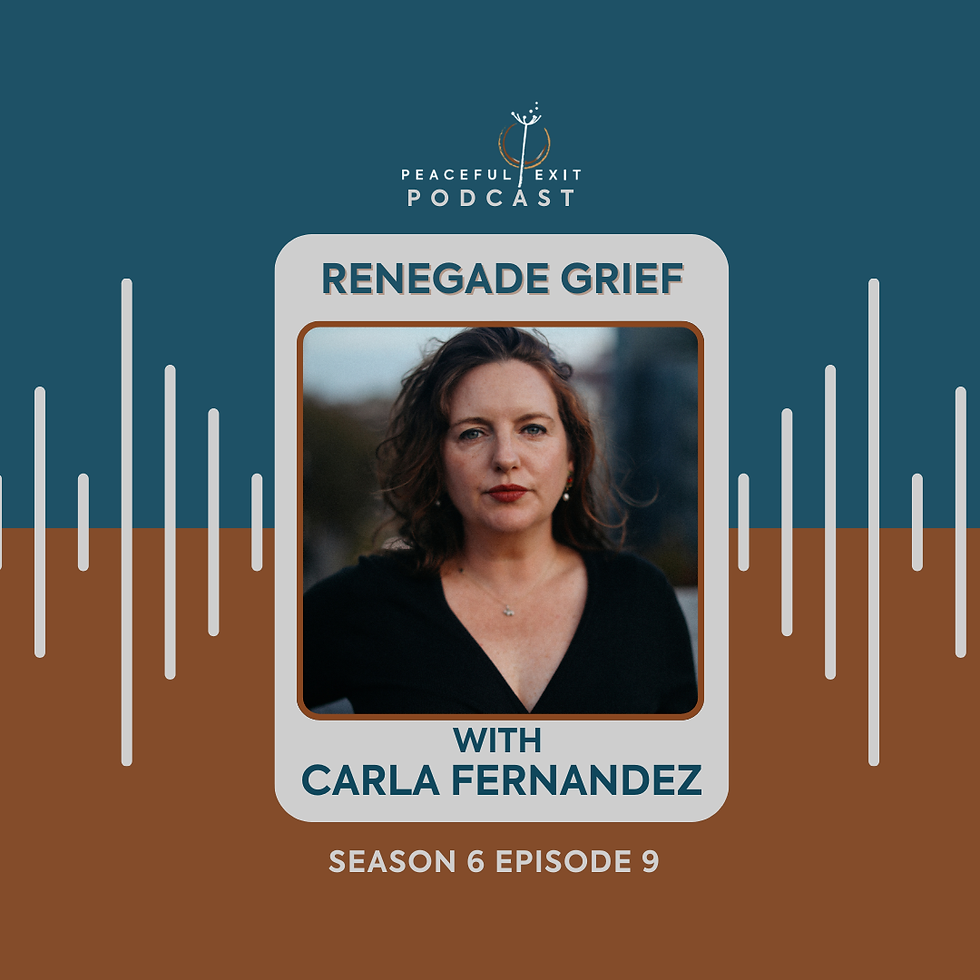
Animal chaplain Kaleel Sakakeeny was overwhelmed by grief after the death of his cat Kyro. And even though pet loss is an incredibly common experience, Kaleel felt like he had nowhere to turn. So, he took matters into his own hands: Kaleel became an animal chaplain, an ordained pastor, and a pet loss and bereavement counselor. He also founded the nonprofit Animal Talks, which supports people who've lost a pet, and helps others become certified to provide counseling. Kaleel tells Sarah why the death of a pet can cut so deeply, and what we really grieve when we mourn our animal companions.
For more information about Kaleel's work, please visit www.animaltalksinc.com
Transcript:
[00:00:00] Kaleel: The animal is the angel of our better selves. I think the pet brings out the best that we are. And you know what happens when the pet dies? The biggest fear is that we will revert back to the other self. That our animal companion took us out of and gave us a bigger heart, more compassion, easier love. So who wouldn't crumble totally when that being died? It's a pure form of love.
[00:00:35] Sarah: Welcome to Peaceful Exit. The podcast where we talk to creatives about death, dying grief, and also life. I'm Sarah Cavanaugh, and my guest today is Kaleel Sakakeeny. After the death of his cat Kyro in 2015, Kaleel was overwhelmed by grief and stunned by how little space there was to talk about it, despite how common this experience is. [00:01:00] Kyro’s death ultimately set him on an unexpected path. He became an animal chaplain, an ordained pastor, and a pet loss and bereavement counselor. In this conversation, we explore why the death of a pet can cut so deeply and what we're really grieving when we mourn our animal companions.
Welcome to Peaceful Exit.
[00:01:22] Kaleel: My pleasure. Thank you.
[00:01:24] Sarah: Let's start by having you share some of your own story. How did you get interested in pet loss and bereavement?
[00:01:32] Kaleel: Every major decision is a function of some event that occurs in a person's life. I mean, there are small events, big events. Some are motivational, some are not. So happens that all my life I've had pets. I call them animal companions, but for the sake of convenience, we, we will say pets. And like everyone who's been a pet parent, I love them dearly, some loves are just simply bigger than others. And this one particular cat was a big love. He was just [00:02:00] magnificent. And when he died, you know, I experienced the kind of grief that I had never experienced before. A grief, sadness, loss. disorientation, couldn't eat. I felt it in my body. All things really begin in the body. All truths are in the body, candidly. Look at the language that we use. My heart skipped a beat. My stomach flipped. The hair in the back of my neck stood up. I felt a chill. I felt all of that. That was my body saying I had suffered a severe loss. So in that context, several years ago, five years ago, the thing to do was, what we always did: went to a therapist. So I called a psychologist, a psychiatrist, and why? I don't really know, but that was the go-to place. It was being treated as a mental illness, as maybe I needed a medicine for it or an antidepressant, but I didn't have a mental problem. I had an emotional and spiritual issue, and it wasn't being addressed because society, candidly, is grief avoidant, grief illiterate. [00:03:00] And our medical model is fix it and get 'em out and return 'em back to normal. But there was no normal to return to. And that left me puzzled as to what to do and where to turn, where to go. So I did some bad things. I wandered the streets. I drank too much, ended up in pubs, bar rooms, and gradually, ever so gradually, it began to dawn on me: look, this is a pain that I'm feeling and others are feeling too. Where do they go? Who do they talk to about it? So I saw somewhere a divinity school that was offering a program in animal chaplaincy. That seemed to me to be the closest answer to what I was looking for. So I enrolled and became an animal chaplain, became subsequently an ordained pastor. Took lots of courses until I became a credential pet grief specialist, loss specialist, and started Animal Talks.
[00:03:55] Sarah: When you initially lost your cat, did the grief about that loss [00:04:00] surprise you?
[00:04:00] Kaleel: Grief is a new emotion. The Greeks wrote about it. Shakespeare wrote about it. Shakespeare famously said, give the sorrow, give the grief words. As old as grief is, it's an unrecognized, unfamiliar, unspoken about emotion. So to answer your question, I was surprised at not so much the newness of the feeling, but why it seems so fresh and powerful and unique. I've suffered loss before. Oh, that's bad. That's sad. But there was something special about this. My body and mind was saying something unique to me, and that's when I became awake.
[00:04:46] Sarah: It sounds like you had a lot of response in your body.
[00:04:49] Kaleel: That’s the only truth there is Sarah. All emotions originate in the body. They could pass through our neurology, our cortexes, and we give them words, we give them [00:05:00] language, which is important in order to heal, quote-unquote heal. But all emotions, if they are an emotion, originate somatically.
[00:05:08] Sarah: I love that. We talk a lot about language here and how we put words around what we're actually feeling in our body. What does it mean to be an animal chaplain? Walk us through this process of becoming ordained, because as I read, you're one of very few ordained animal chaplains. What are you trained to do in this role?
Kaleel: I think that probably about 12 of us who have it actually ordained. But it's becoming increasingly more popular. I just gave a seminar yesterday to an association of veterinarian chaplains, and they are different from animal chaplains. So more and more schools and then more places are offering animal chaplaincy. Each animal chaplain takes a particular path. Some of my colleagues work in shelters, some work in animal control. [00:06:00] Some working in conjunction with veterinarians. I chose to work for want of a better term in counseling, working with people who are suffering a loss, bereavement, the pain of grief. So that's what's happening. And as I listen to other people now becoming trained, I'm a little leery because they're bringing religious concepts or religious points of view into the work where they don't belong. Yesterday one of the participants in the seminar was talking about learning to be a shepherd to the flock as a chaplain, I said, whoa, wait a minute. No one is a shepherd to anybody. That's a hierarchy. You are not a shepherd and they're not your sheep. You are a sheep, and they are a sheep, if you want to use the analogy or the reference point. Each person is their own shepherd. Each person is an expert in their [00:07:00] own grief. Don't assume the possibility of healing, restoring, resolving, and in our society, we think of closure. Why? Why do we want closure? Why would we close anything about the person or the being that we love? So these are concepts that I try very hard in our classes to bring out. We just finished our first ever eight week certification class, certified pet grief specialists and educators, and it was amazing. And they pulled together in a way that was just fantastic. It was almost miraculous. So this is the work of chaplaincy — to attend, to companion, to be present, to hear, to listen.
Sarah: So you were an ordained pastor before
[00:07:48] Kaleel: after the chaplaincy.
[00:07:49] Sarah: Oh, after the chaplaincy.
[00:07:50] Kaleel: After the chaplaincy, one thing led naturally to the other. Because I had already done the work, a lot of the work, so it was just a matter of doing a little more work and [00:08:00] carrying that forward.
[00:08:01] Sarah: I've talked to a lot of faith leaders on this podcast and you are now a pastor. Is there, in your mind, any difference between a Christian or a Jewish or a Buddhist chaplain, or is chaplaincy really an umbrella over all faiths?
[00:08:17] Kaleel: Implicit Sarah in the question is, are there differences between Christians, Muslims, and Jews, differences among the three faiths? If there are differences and they are more sharply etched than similarities, then I suspect that the chaplaincy will be different as a reflection of the difference. But when all is said and done, the similarities are more fundamental than the differences are. So I really would believe that if you lined up a Buddhist chaplain, a Hindu chaplain, a Jewish chaplain, Christian chaplain, if you lined them up, you would see the same through [00:09:00] line, through all of it, if they're true to their work and true to themselves. The problem comes when they overlay tenets or the aspects of the religion, and they start to speak through the religion and not through the spirit. It's a problem.
[00:09:19] Sarah: Yeah. I love that distinction. I also spoke with Luke Lorentzen, a documentary filmmaker. He followed a chaplain named Mati Engel in a hospital caring for COVID patients. It was fascinating to me how she described, really hosting all religions in her chaplaincy, you know, as people were dying and they were alone and just kind of wrapping them in whatever, faith traditions tha they had, it was beautiful.
A friend of mine I was chatting with this morning, I said, we're going to have this conversation with you and she was curious, is, is there an animal [00:10:00] heaven?
[00:10:00] Kaleel: We have people coming to the website and all of a sudden they're coming from Moscow, Beijing, Finland, Norway, Sweden to Ecuador. There are about 55 countries. Consistently, the one blog or article or post that they all go to is: is there an afterlife for my pet? It was fascinating. If you remember when Pope Francis was conducting a papal audience a few years ago, there was a little boy in the audience who was crying his eyes out and the pope approached him and asked him what was wrong and the little boy said he had just lost his puppy and he was very sad. And he wanted to know he would go to heaven and the Pope responded, uncharacteristically or characteristically, in God's eternity there is space or there is room for all of his creatures. And that created somewhat of a firestorm because most [00:11:00] religions don't address the issue of the animal's soul or animal spirit being co-equal with the human spirit and finding a place in heaven. So that was an indication that people are starting to ask this question fairly seriously, and they’re not afraid of it
[00:11:19] Sarah: My mother died about 23 years ago and she had a small dog and no one in the family had a dog at the time. And so we adopted her. She was beloved, because she was a puppy when my mother was diagnosed with stage four cancer and she had such empathy and really just spent a lot of time with my mother as she was in treatment for about a year. And then she came to us and she was still this beautiful, empathetic creature, and she was sadly hit by a car and we had to put her down. She had a broken back, [00:12:00] and it was heart wrenching. This was, she was four years old, so it was three years after my mother had died, and I remember just being completely overcome. And I really felt how Lucy's death sparked unprocessed grief for my mother. Do you understand why people tend to process other big losses like a parent, a friend, or a spouse, through these pet losses?
[00:12:25] Kaleel: First of all, you're right. The death of a pet does trigger, it's a portal to, it does trigger all other kinds of unmourned, unrecognized, unrealized losses. Our relationships with people are very complex. There's betrayal, infidelity, anger, criticism, judgment. Not talking to each other, slamming the door, leaving, getting divorced, hating the person. We don't have that with our pets. Absolutely none of that. The animal is the angel of our [00:13:00] better selves. I think the pet brings out the best that we are. And you know what happens when the pet dies? The biggest fear is that we will revert back to the other self, that negative shallow self that our animal companion took us out of and gave us a bigger heart, more compassion, easier love. So who wouldn't crumble totally when that being died? But no one's relationship to their mother is that good, or their fathers or their siblings. So it's marred. The impulse to grieve deeply is marred by hurt and regret and pain. We don't have that with our animal companions. It's a pure form of love.
[00:13:56] Sarah: Is there any way to prepare [00:14:00] for what we might feel for the loss of a pet and the other grief that may come up?
[00:14:05] Kaleel: All of our lives, in a way, we're preparing for the end, and there is therefore in my mind, a constant grief. We live in a constant sadness and a constant grief because, unrecognized and perhaps unacknowledged, but we know the end game. We know it. We know it for the beings we love. We know it for ourselves. We know it for the rose that we see and smell, the food that we taste, the person that we hold. So I don't know. You can prepare for it by recognizing its inevitability and understanding that that's the soul's journey and the body's journey, if that helps, that you kind of remind yourself that this too shall pass. And maybe through goodness and grace and kindness and love, they diminish the [00:15:00] fear of the unknown of dying. So that might be the only preparation that rings any bell with me.
[00:15:09] Sarah: Do you think the pandemic changed our culture's relationship with death and grief?
[00:15:14] Kaleel: I think it did, but I don't think we're conscious of it. I don't think we've incorporated that into our lives. I think a million people died, Sarah. Now we referred to pre-pandemic, post-pandemic, pre COVID, but we're not touching that grief. That should have shaken us to our foundation. That should have stimulated every preacher, every person, every non-preacher, every human being, to cherish their relationships, and to wonder about life and death. It was a perfect learning opportunity and we screwed it up. We failed to grasp the power — that was a gift in some strange way to [00:16:00] our souls and our spirits, and we missed it as usual.
[00:16:05] Sarah: I think it's so interesting that so many people, including myself, got companion animals. You know, we've all read about the loneliness epidemic. It was sort of exacerbated by COVID, especially young people. How do our pets mitigate this loneliness?
[00:16:25] Kaleel: They don't, unless you see that they do. That requires what I always referred to as a stillness practice. I'm not a big fan of meditation. I don't understand, it confuses me, but stillness I understand. When a person has that stillness and is looking for and able to sense the relationship between him and his pet or her and her animal companion, that comfort or that [00:17:00] absolution that we were referring to takes place. But that requires an awareness and I think it happens naturally with people who have pets. For most of it, they can't avoid it. That's why the love is so great. It's bringing, as I said before, it's bringing forth something that nobody else does.
Sarah: Yeah.
[00:17:21] Kaleel: Who wants to lose that? And so the grief is horrific. Not just the grief because the animal we love died, because we're afraid that our better selves died too.
[00:17:33] Sarah: Hmm. So it's twofold. It might spark old unprocessed grief, but it also sparks self-awareness in that we are a different person with that loving soul.
[00:17:45] Kaleel: I think so.
[00:17:46] Sarah: It's beautiful.
[00:17:47] Kaleel: And that's why we talk about making meaning from the death, finding a way. Because it's also, I hate the word but I'll use it anyway, therapeutic [00:18:00] in a sense. It helps a person begin to remember their lives with their pet, with more joy than sadness. They never resolve this, but they reconcile it. Meaning they bring the loss and the grief into their lives, and that often motivates people to make meaning. That could be working in a shelter, could be helping senior citizens buy dog food, change the cat litter. It could be planting a garden in memory of your animal companion, your pet. So the making of the meaning then begins to, I think, help us hold onto that better self
Sarah: So are you talking about rituals following the loss of a pet?
[00:18:54] Kaleel: I certainly am.
[00:18:55] Sarah: Yes.
[00:18:55] Kaleel: Yeah. Absolutely. So yeah, that's a good point.
[00:18:59] Sarah: How important those [00:19:00] rituals are to help us process the grief.
[00:19:03] Kaleel: We yearn, we hunger for that kind of connection, that kind of participation is something greater than ourselves.
Sarah: Talk a little bit about Animal Talks. How did you come to start it? What did you discover in the loss of your beloved cat that informs your work?
Kaleel: Yeah, I mentioned that — not being able to find what I was looking for, which was some understanding of the loss. And as I said, the medical model was to fix me, but there was nothing broken except my heart. And there was no pill for sadness. So that led me to wonder, the other people feeling the same way and having no place to turn, I started as a professional coach, and that lasted a very short period of time. But that was a stepping stone, a transition. Then I began to think about this and feel it. And to this day, I cannot remember [00:20:00] where the name Animal Talks came from, and I cannot remember consciously making the decision to start this organization. I say it's a blur. I believe I was guided. And so Animal Talks came out of my loss, out of my realization that there was no one that really I could relate this loss to. Everyone was trying to tell me what to do, trying to fix it, trying to heal me, and all they wanted was somebody to hear me and understand. And so that's how animal talks came. Then we became a nonprofit, 501 C3. So our work is largely educational seminars, lots of podcasts, teaching, grief certification workshops. We have these monthly gatherings, sometimes there are five people, sometimes there are 10, sometimes there's nobody. Then I have my own personal one-on-one grief work with individuals. Sometimes they go to the group and that's not quite enough. The [00:21:00] pain is too acute.
[00:21:01] Sarah: So your cat's name was Kyro.
[00:21:03] Kaleel: K-Y-R-O. Yeah.
[00:21:05] Sarah: Is there anything in your life now that keeps her memory alive?
[00:21:10] Kaleel: Yes of course. You can't see it. I could turn my computer, but there's a picture of Lyric, there's a picture of Kyro. There's another picture of Kyro, another picture of Lyric, a picture of my teacher, Swami Salakatananda. There are several pictures of my dog, whom I have now. There's a picture of a jackal and a fox. Fox and the wolf are sort of my power animals, so they're all over here. And then downstairs we have what I call a memory spot where there are more pictures and their ashes and maybe a water bowl. I advise people to do that like they want, first thing they wanna do often is to get rid of the dog collar or the feeding bowl or whatever cause they just thought they'll be reminded. But keep it there. Be able to walk by it and touch that, to touch that spot, to touch that place and feel [00:22:00] connected.
[00:22:01] Sarah: Tell me about the dog in your life.
[00:22:03] Kaleel: Oh, her name is Stellina. She's a beagle, I don’t if you know Beatles.
Sarah: I don’t.
Kaleel: They are vex, they are vexing. They're the most manipulative dogs in the world. What should be a two minute walk around the block turns into two hours because they are so scent-oriented. And she's charming. She sleeps with us in bed, sometimes under the sheets, sometimes on top of the sheets. She knows exactly how to play us, her eyes cut through everything and every objection that we have. So she is the love of our lives.
[00:22:37] Sarah: Has your grief changed as you age?
[00:22:40] Kaleel: Oh, I think I'm more patient with it. I'm more gentle with it. It can still drive me crazy. It's an overwhelming emotion and maybe unlike, well I can't say anger cause anger can pass, but it doesn't pass, sometimes it's constant also. As I said, the awareness [00:23:00] that Stelli will die or I will probably die before her, or maybe my wife will die before all of us. And, and yet without that, without the constancy of the reminder of grief, there can be no love and no joy. Gibran, you know, Kahlil Gibran the prophet, he talks about them being co-joined emotions: grief and love and joy. So you can't have one without the other. So would I wish a life without grief? No, because then it would take away my love, then I'd be barren.
Sarah: Does the work you do give you peace?
[00:23:37] Kaleel: No. It gives me purpose. It may give me peace at some point, but it gives me purpose.
[00:23:44] Sarah: Is there something that you would like to have at the end of your life with you, whether it be people or pets, or warm socks, or is there anything you think about that you would like to have at the end of your life?
[00:23:57] Kaleel: I think I would probably [00:24:00] want to have a sense that it's all okay. That don't worry, Kaleel, you will be okay. You will be taken care of and the people you love will be okay too. Now you're gonna start to make me cry and that would be embarrassing.
[00:24:18] Sarah: Well, that's beautifully said. What does a peaceful exit mean to you?
[00:24:22] Kaleel: I think for those who truly believe that their soul will ascend, their spirit will be reunited with the loved ones that they've lost, or there will be the face of God or the face of the creator, and that touch and that presence, will be beautiful, magnificent, comforting. Then I guess there is that peaceful exit because they're merely moving from one room to the next. They're just, the light is not being put out, as [00:25:00] Tagore says. It’s just that the lamp is being lowered because the dawn is rising. That's a peaceful exit.


This was a very interesting and informative read that I truly enjoyed. The way the author presented accounting ideas in a simple and engaging manner made it easy to follow. As a student managing multiple accounting assignments, I sometimes take time to read blogs like this for motivation. At times, many learners also search for Accounting Assignment Help when they need extra academic guidance. Posts like this help maintain focus and encourage a positive approach toward studies.